
The Go-Live Gap, episode 4
Is the forward deployed engineer role a bubble?
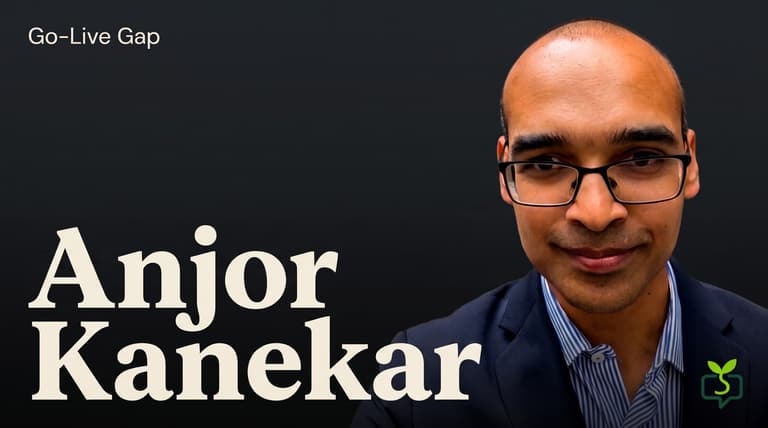
A seven-year Palantir FDE and hiring manager answers, with Anjor Kanekar
Anjor Kanekar, Founder, Platypus Tech; FDE advisor; formerly forward deployed engineer and hiring manager at Palantir (2015 to 2022)
Forward deployed engineers exist because there is a gap between what AI models can do and what an enterprise can actually use, and someone has to gather the business context, find where the value sits, and shape the application layer in between. Anjor Kanekar spent seven years as an FDE at Palantir, from before Foundry's first release through its maturity, and became one of a handful of FDE hiring managers in London. He argues the role is a bubble mainly where companies copy the end state without the first-principles thinking that produced it, explains the difference between an FDE and a solutions engineer with a Lego dragon, and describes how Palantir paired, staffed, and hired for the job.
Chapters
- 00:00 Is the FDE role a bubble?
- 02:54 Anjor's background: physics PhD to Palantir
- 05:43 Becoming an FDE hiring manager in London
- 08:44 First deployment: the insurance model that broke
- 11:33 Advice for a new FDE: be curious, be proactive
- 12:57 The Lego essay: FDE versus solutions engineer
- 16:56 Keeping morale in a structure built on friction
- 19:10 The pendulum from bespoke to platform, 2015 to 2022
- 22:55 What AI changed and what it did not
- 24:24 Services firms with software margins
- 26:36 Driving focus in a services model
- 30:07 Building the FDE model from first principles
- 33:41 Deployment pairs: strategist as CEO, FDE as CTO
- 37:17 Spiky people and the resourcing team
- 41:19 Prioritization: talk to users, watch what they do
- 45:07 Do users know what they want?
- 46:46 What's next for Anjor, and AI for physics
Key takeaways
From Anjor Kanekar, Founder, Platypus Tech; FDE advisor; formerly forward deployed engineer and hiring manager at Palantir (2015 to 2022).
- The FDE role fills the product R&D gap. Models improve daily, enterprises struggle to locate the value, and the FDE takes the technology, gathers business context, and shapes what needs to be built.
- An FDE differs from a solutions engineer in what happens after the first attempt fails. The solutions engineer stops at the existing bricks. The FDE modifies the bricks to build the exact dragon, then brings the misshapen bricks back to the core team so the platform improves.
- The friction between FDE and product incentives is by design. Some Palantir leaders called it the secret, and how to keep morale up inside that structure remains an open question for him.
- Palantir deployed in pairs: a deployment strategist as CEO and an FDE as CTO of a two-founder startup with one customer. A separate resourcing team matched spiky individuals into teams whose combined skills covered a job description no single person could.
- Job descriptions that ask for a consultant who can also code for a frontier lab describe a person who rarely exists. Hiring looked for exceptional strength in a few areas plus value orientation, grit, proactivity, humility, and speed of learning.
- Post-AI, a services firm can reach software margins by running the FDE motion on internal tooling and selling outcomes through a human interface. He points to a services company acquired by a frontier lab as the example.
- Prioritization comes from talking to users and watching what they do, then asking why until the end state they want is clear. Users rarely know what tool they want; they usually know the pain.
- Advising a fintech on building an FDE function, he found the pairing model hard to transplant into a culture with separate project managers and solutions engineers, so they scoped the change to chosen individuals and expanded from what worked.
Questions this episode answers
What is the difference between a forward deployed engineer and a solutions engineer?
In Anjor's Lego thought experiment, both start by building the dragon from existing bricks and instructions. When the child says it looks more like a parrot, the solutions engineer stops. The FDE changes the bricks until the dragon is right, then takes the changed bricks back to the brick designers, which is the product R&D loop.
Why does Anjor think the FDE role might be a bubble?
Because many companies copy parts of Palantir's end state instead of asking from first principles what their market, platform, and people require. The role is different at every company and each person makes it their own, so a copied job description rarely produces the value.
How did Palantir staff and hire forward deployed engineers?
Deployments ran as pairs, a deployment strategist and an FDE. A resourcing team matched people to deployments based on what each wanted to grow in and what the team composition needed. Hiring looked for spiky profiles, exceptionally strong in a few areas, and used trusted anchor interviewers alongside a small number of hiring managers per office.
How does AI change the FDE job?
Pro-code workflows replace much of the drag-and-drop application building the platform once needed, since anyone can spin up a front end quickly. What has not changed is finding where the value is, decomposing the problem from first principles, and solving it.
Where Stipulate fits
Anjor's Palantir deployments ran as two-person startups with one customer, and the context those pairs gathered mostly lived in their heads and their channels. Stipulate captures commitments and action items from the customer channel as the conversation happens, so the context survives a handoff, a rotation under a year, or a vacation, and the lead can see engagement health without interrupting the pair.

About Anjor Kanekar

Founder, Platypus Tech; FDE advisor; formerly forward deployed engineer and hiring manager at Palantir (2015 to 2022)