
The Go-Live Gap, episode 3
What does a forward deployed engineer actually do?
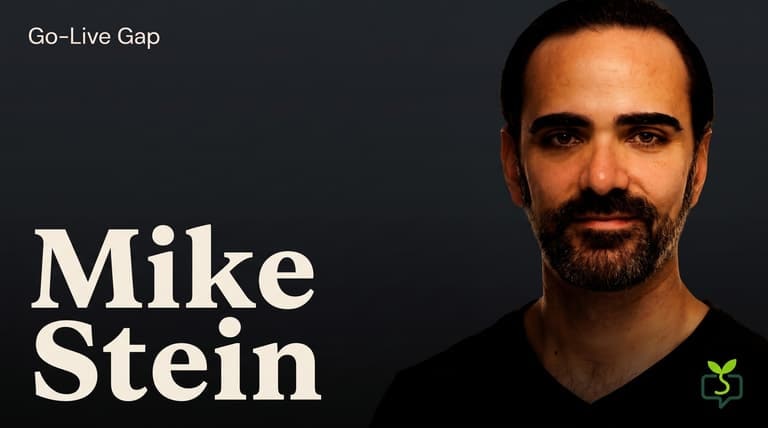
Ten years inside Palantir's FDE model, with Mike Stein
Mike Stein, Process and productivity expert, Processes for People; formerly deployment strategist and customer success lead at Palantir
A forward deployed engineer works embedded with a customer, using a software platform to solve that customer's problem while feeding what they learn back into the platform's roadmap. Mike Stein spent more than a decade at Palantir as a deployment strategist working alongside FDEs and later led its first government customer success team. In this conversation he explains why the role behaves like running a small startup inside each account, why the requirement sheet is rarely the real checklist, why Palantir walked away from some customers on purpose, and why he expects the share of FDEs relative to traditional engineers to rise as AI makes demos cheap and judgment scarce.
Chapters
- 00:00 What people get wrong about FDEs
- 01:55 From finance to Palantir deployment strategist
- 04:35 Advice for anyone entering the FDE role
- 05:56 FDE versus solutions engineer
- 07:06 What makes someone excel: autonomy and uncertainty
- 09:26 When an FDE model is the wrong fit
- 11:41 Culture that attracts FDE talent
- 13:27 Bespoke work versus productizing: the pendulum
- 16:41 Leadership blind spots and middle managers
- 21:07 Firefighting, burnout, and respect from sales and engineering
- 27:12 Sales cycles in an FDE model
- 31:22 Moving a company to the FDE model
- 33:27 Hire or grow, and measuring FDEs
- 36:43 How AI changes demand for FDEs
- 38:50 FDEs for small businesses
- 40:13 Where to find Mike
- 41:19 Where the FDE role goes from here
- 42:39 The question few people ask: burnout
Key takeaways
From Mike Stein, Process and productivity expert, Processes for People; formerly deployment strategist and customer success lead at Palantir.
- The FDE's purview is broad. Each FDE is effectively running a small startup for their customer, finding the right thing to do and doing it, and pivoting as the signal from users changes.
- The requirement sheet is rarely the real checklist. The real list might be two items or a thousand, and it typically comes from the operators using the software, who are often different people from those who wrote the requirements.
- Hiring matters more than training. Onboarding for an FDE should be short, mostly shadowing and open-ended conversation, with a real customer project inside a week or two.
- FDEs at Palantir typically spent less than a year with each customer, and the hiring thesis for a person was usually wrong within six to twelve months once their real strength showed.
- Fold a lot of mediocre hands early. Palantir walked away from customer relationships where the conditions for success were absent, and Mike considers that a large part of why the model worked.
- Booking many customers can be the wrong metric for an FDE model. Shorter contracts with faster renewals reward a team for finding three more things to fix in the first six months.
- Leaders should forward deploy themselves: join demos and trainings, talk to FDEs on the ground, and invest in middle managers who coach rather than chase deliverables.
- AI raises the value of FDEs. A decent demo is cheap now, so the differentiator becomes an engineer who understood the problem from inside the customer and can shape the product accordingly.
Questions this episode answers
Is a forward deployed engineer the same as a solutions engineer or a consultant who can code?
Mike's answer is that the FDE has a much broader purview. A solutions engineer or consultant is typically there to do one type of thing, a sales action, a training, a support queue. The FDE is finding the right thing to do for the customer and doing it, and is expected to bring back what should be built next.
How does a company know it is ready for an FDE model?
Ask why, and expect a good answer. There should be a product in development that is not yet a finished SaaS product, a willingness to change the org chart, reporting, mentorship, and hiring around the role, and goals the FDEs on the ground can act on with their autonomy.
How do you measure a forward deployed engineer?
Index on impact for the client and for the product. On the product side, ask how often the company changed its mind because of what an FDE found, whether they were right, and how many places a build was reused beyond the customer that inspired it.
What are the exit paths from an FDE career?
The most common path Mike saw was founding a company, since an FDE has already run a startup-like operation. Others moved into running businesses or into civic and government institutions. There is no fixed ladder, and he considers the pedigree valuable.
Where Stipulate fits
Mike describes the FDE's hardest information problem as getting what the front line learns up to the leaders who steer, and across to sales, without metrics that mislead. Stipulate reads the customer Slack channels where forward-deployed work already happens, keeps a live list of what was promised and what is stalling, and gives the lead a health read per engagement. The judgment stays with the FDE.

About Mike Stein
Process and productivity expert, Processes for People; formerly deployment strategist and customer success lead at Palantir